CPF changes from 1 January 2027: what employers need to do.
CPF contribution rates rise again for employees aged above 55 to 65 from 1 January 2027. The new rates, what they cost per employee, the CPF Transition Offset, and a checklist for your January payroll.
By MTM Associate · · 5 min read
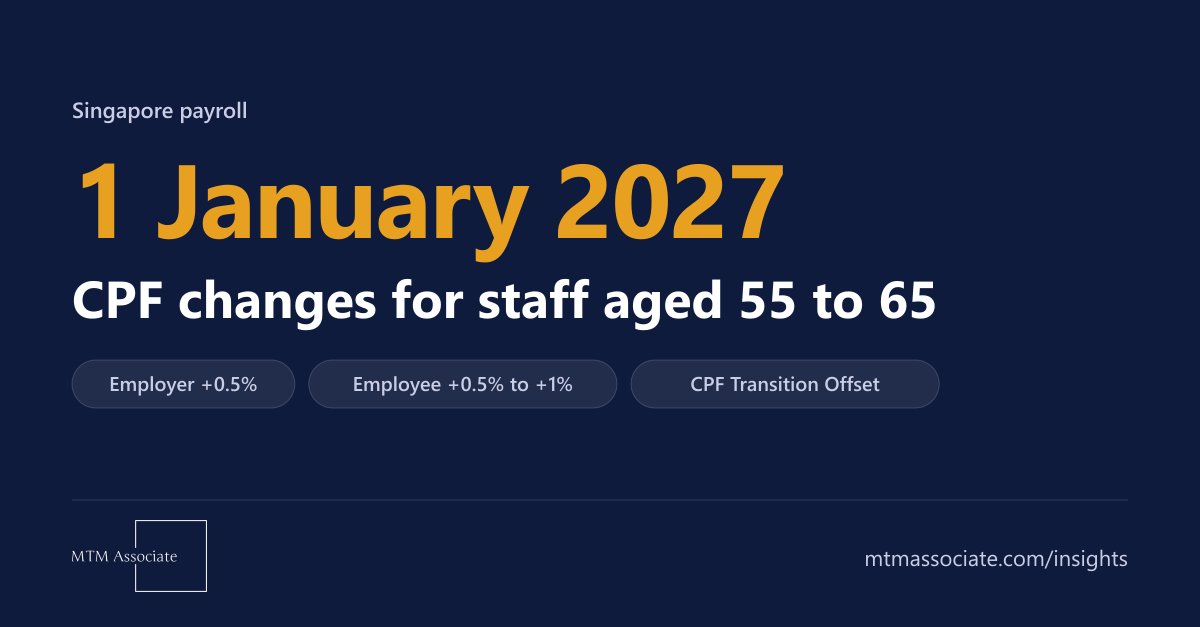
From 1 January 2027, CPF contribution rates go up again for employees aged above 55 to 65. Employers pay 0.5 percentage points more. Employees pay 0.5 to 1 percentage point more, so their take-home pay falls.
The change per person is small. But it touches every payslip for staff in these age bands, and it is far easier to get right in December than to correct in February.
Here is what changes, what it costs, and what to do before your January payroll.
The new rates
The new rates apply to wages earned from 1 January 2027, for employees earning more than S$750 a month (CPF Board).
| Employee’s age | Employer | Employee |
|---|---|---|
| Above 55 to 60 | 16% → 16.5% | 18% → 19% |
| Above 60 to 65 | 12.5% → 13% | 12.5% → 13% |
In total, contributions rise from 34% to 35.5% for employees aged above 55 to 60, and from 25% to 26% for those aged above 60 to 65.
Nothing changes for other employees:
| Age | Employer | Employee | Total |
|---|---|---|---|
| 55 and below | 17% | 20% | 37% |
| Above 65 to 70 | 9% | 7.5% | 16.5% |
| Above 70 | 7.5% | 5% | 12.5% |
A few more points from CPF Board:
- Senior workers earning more than S$500 and up to S$750 a month, who contribute at phased-in rates, see those rates rise in proportion.
- The graduated rates for first- and second-year Singapore Permanent Residents do not change.
- With this step, the rates for employees aged above 60 to 65 reach their target level.
Where the extra money goes
The increase is not a new tax. It goes into the employee’s CPF Retirement Account, up to their Full Retirement Sum. Once that is set aside, it goes to their Ordinary Account (CPF Board).
That is worth explaining to your staff. “Your take-home pay is S$60 lower because S$60 more is going into your retirement savings” lands better than a smaller payslip with no warning.
What it costs per employee
Monthly figures for illustration, before CPF’s rounding rules:
| Aged 58, earning S$6,000 | Aged 62, earning S$4,500 | |
|---|---|---|
| Extra employer CPF | +S$30.00 | +S$22.50 |
| Less in take-home pay | −S$60.00 | −S$22.50 |
| CPF Transition Offset (0.25%) | S$15.00 | S$11.25 |
| Net extra cost to the employer | S$15.00 | S$11.25 |
For most small companies, the cost is a rounding error on the payroll. The bigger risk is getting the rates wrong.
The CPF Transition Offset
To soften the increase, employers receive a CPF Transition Offset (CTO) equal to half of the increase in the employer rate. For 2027, that is 0.25% of wages, up to the CPF salary ceiling, for each Singapore Citizen and Permanent Resident employee aged above 55 to 65 (IRAS).
What you need to know:
- You do not apply. It is paid automatically to employers who made their CPF contributions on time.
- It comes later. IRAS pays these offsets twice a year: wages paid from January to June are paid out in September, and wages paid from July to December are paid out in March of the following year.
- It needs GIRO or PayNow Corporate. IRAS does not issue cheques. IRAS notifies eligible employers by letter, and you can see the breakdown in myTax Portal.
So in cash-flow terms, you pay the full increase every month and get half of it back months later.
Senior Employment Credit
Separately, the Senior Employment Credit (SEC) still runs for wages paid up to 31 December 2027. It gives employers 2% to 7% of wages for Singapore Citizen employees aged 60 and above who earn below S$4,000 a month, depending on age: 2% for ages 60 to 64, 4% for 65 to 68, and 7% for 69 and above, on wages up to S$3,000, tapering to nil at S$4,000 (IRAS). It is paid on the same schedule, with no application needed.
Your checklist for the January 2027 payroll
- Update your payroll software. Check that it has the 2027 rates loaded, and confirm it on a test payslip against CPF Board’s contribution calculator.
- List every employee aged above 55 to 65. Rates follow the employee’s age band, so check birth dates, including anyone moving into a new band during 2027.
- Check anyone earning S$500 to S$750 a month. Their phased-in rates also rise.
- Tell affected staff before the January payslip. Explain the change and where the money goes.
- Update your 2027 payroll budget. Include the extra employer CPF, and remember the offset arrives months later.
- Make sure IRAS can pay you. Set up GIRO with IRAS or register for PayNow Corporate, so the CTO and SEC reach you.
- Pay CPF on time. The offsets only go to employers who make timely CPF contributions.
Sources
- CPF Board: Increase in CPF Contribution Rates from 1 January 2027
- CPF Board: Changes to CPF contribution rates for senior workers from 1 January 2027
- CPF Board: Employer support for the 2027 increase
- CPF Board: Budget 2026 highlights
- IRAS: Senior Employment Credit, CPF Transition Offset and Enabling Employment Credit
This article is general information as at 15 November 2026, not tax or payroll advice for your situation. Check the rates against CPF Board’s contribution tables, or speak to us, before you run your January payroll.